About Panvel, Navi Mumbai: Growth, Connectivity & Why It Matters
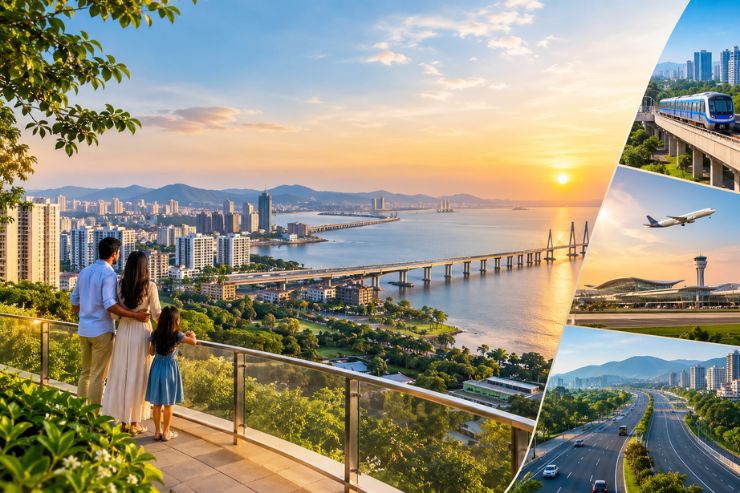
If you are exploring a home at Hiranandani Fortune City Panvel Project, you are looking at a city that is changing fast. Panvel is no longer a quiet corner of Navi Mumbai. It has become a key growth zone in the Mumbai region. This page explains what Panvel is today, how it got here, and why it sits at the centre of the region's next chapter.
What Is Panvel and Where Does It Fit in Navi Mumbai?
Panvel is a city in the Raigad district of Maharashtra. It sits in the southern part of Navi Mumbai, close to the harbour and the Konkan coast. Navi Mumbai itself was planned in 1972 by CIDCO as a satellite city to ease pressure on Mumbai. The idea was to build a network of self-contained nodes, each with homes, jobs, schools, and recreation.
Panvel grew on its own for many years as a railway town and market centre. But in the last decade, it has become a focal point for the region's biggest infrastructure projects. The airport, the sea bridge, and the metro have all come up around it. That shift has changed Panvel from a pass-through town to a destination.
The Infrastructure Driving Panvel's Growth
Three major projects have reshaped Panvel's future. They are the airport, the bridge, and the metro.
The Navi Mumbai International Airport (NMIA). This greenfield airport opened for domestic flights on December 25, 2025. International operations began in July 2026 with a direct route to Abu Dhabi. The airport sits close to Panvel and spreads over 1,160 hectares. It has already connected to 46 domestic destinations and handles around 150 flights a day. For Panvel, this means jobs in aviation, cargo, hotels, and retail. It also means easier travel for residents.
Atal Setu (Mumbai Trans Harbour Link). This is India's longest sea bridge. It connects Sewri in Mumbai to Nhava Sheva in Navi Mumbai. For Panvel residents, Atal Setu cuts travel time to South Mumbai by a large margin. You can now reach the island city faster for work, school, or leisure. The bridge also takes pressure off older routes like the Sion-Panvel Highway.
Navi Mumbai Metro Line 1. This line started running in November 2023. It covers 11.1 km between CBD Belapur and Pendhar with 11 stations. More extensions are in the works. In January 2026, the state approved Metro Line 8, a 35 km corridor linking Mumbai airport with Navi Mumbai airport at a cost of ₹22,862 crore. This line will have 20 stations and will improve access across the region.
Panvel's Real Estate Market in 2026
The numbers show how much Panvel has changed. Property prices in Panvel rose 76% from 2021 to mid 2026, according to ANAROCK data. That is higher than the 64% growth seen across Navi Mumbai as a whole during the same period.
Here is a quick look at the market:
| Metric | Panvel (2026) | Mumbai (for comparison) |
|---|---|---|
| Price Growth (2021 to 2026) | 76% | Varies widely by area |
| Rental Yields | 3% to 4.5% | 2.5% to 3% |
| Homes Launched (2021 to H1 2026) | 42,330 units | Not directly comparable |
| Land Transacted (last 5 years) | 6,400+ acres | Not directly comparable |
The launch of new homes has been strong. Between 2021 and H1 2026, 42,330 homes were supplied in Panvel. About 47% of these were priced between ₹50 lakh and ₹1 crore. This shows demand from first-time buyers and young families.
Connectivity: How Panvel Links to the Rest of the Region
Panvel was always a railway town. It is a major junction on the Konkan Railway and the Central Railway suburban network. But road and air links have grown fast.
- By Road: Panvel connects to the Mumbai-Pune Expressway, the Sion-Panvel Highway, and the old Mumbai-Pune highway. Atal Setu provides a direct sea link to Mumbai. A coastal road is planned to connect Kharghar, CBD Belapur, and Nerul.
- By Rail: The suburban rail network links Panvel to Vashi, Nerul, CBD Belapur, and Thane. The Konkan Railway connects it to coastal Maharashtra, Goa, and Karnataka.
- By Air: The Navi Mumbai International Airport is a short drive from most parts of Panvel. It has domestic flights to 46 destinations and international flights to Abu Dhabi.
- By Metro: Navi Mumbai Metro Line 1 runs from CBD Belapur to Pendhar. Metro Line 8, approved in 2026, will link Mumbai airport to Navi Mumbai airport.
This mix of rail, road, air, and metro makes Panvel a multimodal hub. You can reach most parts of the Mumbai region without relying on a single mode of transport.
What Is Mumbai 3.0 and How Does Panvel Fit In?
Mumbai 3.0 is a term used to describe the next phase of growth in the Mumbai region. Mumbai 1.0 was the original island city. Mumbai 2.0 was the expansion into the suburbs and Navi Mumbai. Mumbai 3.0 is about planned, connected corridors beyond the traditional boundaries.
Panvel is at the heart of this shift. Its location near the airport, the sea bridge, and the expressway makes it a natural node for growth. Integrated townships fit this vision because they offer homes, schools, shops, and recreation in one place. For homebuyers, Mumbai 3.0 means more space, better planning, and easier access to jobs across the region.
Social Infrastructure in and Around Panvel
A city is only as good as the life it offers. Panvel and the wider Navi Mumbai area score well on social infrastructure.
- Education: Navi Mumbai has a literacy rate of around 98%, one of the highest in India. Reputed schools like DPS and Ryan International operate in the area. Engineering and medical colleges are also within reach.
- Healthcare: Major hospitals like MGM, Apollo, and Tata Memorial have a presence in Navi Mumbai. Smaller clinics and diagnostic centres serve local neighbourhoods.
- Retail and Entertainment: Shopping malls like Inorbit, Raghuleela, and Seawoods Grand Central are a short drive away. Multiplexes, restaurants, and cafes are spread across the region.
- Green Spaces: Navi Mumbai reserves a large share of its land for open areas. CIDCO planned the city with no-development zones and afforestation in mind.
Jobs and the Local Economy
Panvel's economy is diverse. It does not depend on a single industry.
- Aviation: The Navi Mumbai International Airport is a major employer. It supports jobs in ground handling, cargo, retail, hospitality, and airline operations.
- Port and Logistics: Jawaharlal Nehru Port Trust (JNPT) is one of India's largest container ports. It drives logistics and shipping work in the region.
- Industry: MIDC areas in Taloja and nearby zones host manufacturing and processing units.
- IT and Offices: IT parks in Vashi, CBD Belapur, and Airoli provide tech and back-office jobs. Many residents commute there by rail or road.
This mix makes the local economy more stable. If one sector slows, others can help carry the load.
Why Hiranandani Fortune City Panvel Fits Here
Hiranandani Fortune City Panvel is a 588-acre integrated township in the Mumbai 3.0 corridor. It has over 2,200 delivered homes across 19 towers. More than 100 acres are green space, and an adjoining reserve forest of about 25 acres adds to the natural setting.
The township is designed as a self-contained ecosystem. It includes an on-site school, retail spaces, healthcare access, and a 90,000 sq.ft. Club Royale. The idea is simple: daily needs should be within walking distance. That is what integrated township living means.
The location is strategic. It is close to the Navi Mumbai International Airport, the Mumbai-Pune Expressway, and the Panvel railway junction. Residents can reach Mumbai via Atal Setu or the suburban rail network. Upcoming metro extensions will add more options.
For families, this reduces daily stress. For investors, it means strong rental demand from people working in the airport zone, logistics, and nearby industries.
The Road Ahead for Panvel
Panvel is not done growing. Several projects are in the pipeline.
- Metro Line 8: Approved in January 2026, this 35 km line will connect Mumbai airport with Navi Mumbai airport. It is expected to take three years to build once approvals are complete.
- Airport Expansion: NMIA will expand in phases. International flights are expected to increase in the coming years.
- Coastal Road: The Kharghar Coastal Road is planned to improve access to the airport and ease traffic on existing routes.
- NAINA: The Navi Mumbai Airport Influence Notified Area covers 370 sq.km around the airport. CIDCO is planning new townships and infrastructure here.
These projects will continue to push growth into Panvel and nearby areas. Buying a home here today is buying into a city that is still being built.
Get in Touch
To learn more about Panvel, Navi Mumbai, or Hiranandani Fortune City, download the brochure or speak with our sales team. We can share current pricing, availability, and help you decide if this growth corridor is right for you.